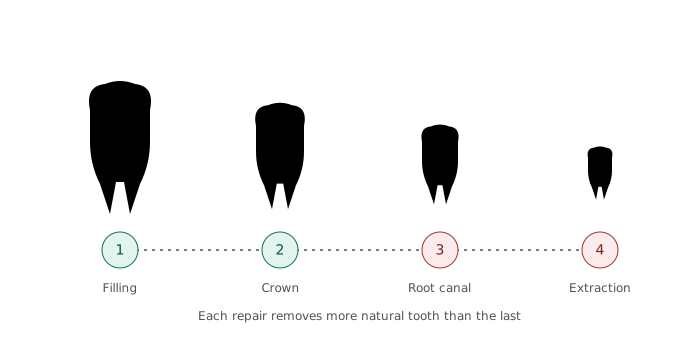
We remove it along with any decay underneath, which takes away more natural tooth than was there before.
After a few rounds of this, a crown becomes necessary to hold what's left together.
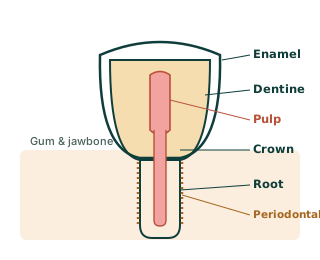
Further damage or decay can mean the nerve tissue needs treating too.
A longer-lasting repair earlier breaks this cycle — and usually works out cheaper over a lifetime, even when it costs more upfront.
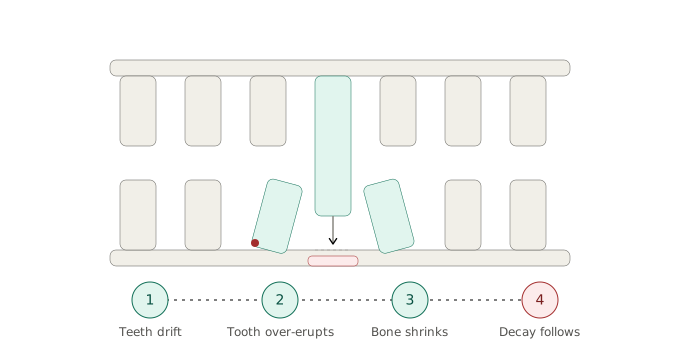
They move towards the space and, over months and years, tilt into it — weakening their own stability and creating awkward shapes that are harder to keep clean.
With nothing left to bite against, it slowly grows out of its socket into the space, upsetting the bite.
Bone is maintained by the chewing forces passed through the teeth — once that stimulus goes, the body reabsorbs it.
Drifted teeth are harder to clean, which is why one lost tooth so frequently leads to more.